US supreme Court signals federal workers could lose job protections
A new Supreme Court opinion suggests the president could eliminate civil service safeguards by controlling which officials hear worker disputes.
By Max Fletcher
28 May, 2026
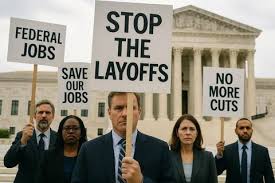
A Supreme Court decision handed down Tuesday has alarmed federal workers. The case, Margolin v. National Association of Immigration Judges, appears to be about whether immigration judges can give public speeches. But two justices used it to sketch a path toward eliminating most job protections for federal employees.
Justice Clarence Thomas wrote the opinion, and Justice Amy Coney Barrett joined it. The pair suggested that President Trump could strip civil service protections simply by controlling the agencies that hear worker complaints. If no agency exists to hear disputes, they reasoned, then federal workers would have nowhere to turn if they were illegally fired.
Barrett is considered a moderate on the Republican-controlled court. Her decision to endorse Thomas's argument signals that a court majority may agree with this approach. This matters because civil service protections have shielded federal workers from arbitrary firing since President Chester A. Arthur signed the Pendleton Civil Service Reform Act in 1883.
The legal theory behind Thomas and Barrett's reasoning builds on what conservatives call the "unitary executive" doctrine. This idea says the president must have broad power to fire top government leaders. But historically, this theory did not extend to ordinary federal employees like postal workers or Social Security clerks.
The full Supreme Court reversed the lower court's decision on narrow grounds. The court said the Fourth Circuit should not have discussed what happens if the Merit Systems Protection Board—the agency that hears civil service disputes—stops functioning, because the lawyers in the case never raised that question. But Thomas and Barrett went further, arguing that if the board ceases to exist, federal workers simply lose their legal remedies.
Federal civil service laws exist to prevent what happened before 1883. Back then, whenever a new president took office, thousands of government workers lost their jobs to political appointees. President James A. Garfield spent much of his time deciding which job-seekers got federal positions, often based on whether they had connections to powerful politicians. The system bred corruption, made government inefficient, and meant skilled workers avoided federal jobs because their positions would vanish with each election.
Civil service protections today do more than prevent mass firings. They shield federal workers from being forced to participate in political activity. They protect whistleblowers who report wrongdoing. They ensure the government is staffed by trained professionals who remain across different presidencies.
The Merit Systems Protection Board enforces these rules. When federal workers believe they were illegally fired or disciplined, they file cases with the board. Early in his second term, Trump fired one of the board's three members, leaving it unable to operate. He also fired Hampton Dellinger, the Special Counsel of the United States, who investigates civil service law violations. Trump attempted to replace Dellinger with a far-right podcaster who later withdrew after Politico reported comments the podcaster made about having a "Nazi streak in me from time to time." Trump then assigned Dellinger's duties to US Trade Representative Jamieson Greer.
Trump has since appointed a second board member, giving the board the minimum two people needed to operate. But for several months, the board had only one member and could not hear cases.
This is where the Margolin case becomes crucial. The lower court, the Fourth Circuit, ruled that if the board became nonfunctional, federal courts would have to step in and hear civil service disputes. Otherwise, federal workers would have no way to challenge illegal firings. Thomas and Barrett rejected this reasoning, saying that if the board does not exist, federal workers have no recourse.
The practical consequence is straightforward: Trump could eliminate federal civil service protections by firing one of the two current board members. The board would cease to operate. Federal workers could then be fired for any reason—or for no reason at all—with no legal remedy, even if fired because of their political beliefs.
This aligns with other recent Supreme Court decisions. Last July, in McMahon v. New York, the court allowed the Trump administration to fire roughly half the Department of Education's workforce. The three Democratic justices dissented, but the Republican justices offered no explanation. That decision suggested the court's Republican majority did not support civil service protections.
Barrett's willingness to endorse Thomas's argument in Margolin reinforces that pattern. Together, these decisions suggest the court wants to overturn a principle accepted in 1883: that the federal government should employ professional civil servants who cannot be fired simply because a new political party controls the White House.
Reporting incorporates material from a third-party source. Original