Google's AI struggles with basic spelling and letter counting
The search giant's new AI feature repeatedly misspells words and miscounts letters, exposing a fundamental weakness in how language models process text.
By Polaris Newsroom
28 May, 2026
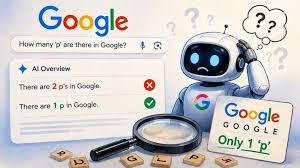
Google's new AI-powered search feature has made embarrassing spelling mistakes. When asked how many Ps are in the word "Google," the system says two. It also claims there is one R in "poop" and two Ds in "journalism," though it spells the word j-o-u-r-n-a-d-i-s-m. Even the last name of the U.S. president stumped the system, which spelled it t-r-p-u-m.
This is not Google's first AI stumble. When the company first added AI Overviews to Search, the feature cited satirical posts from The Onion and Reddit. It advised people to eat rocks and put glue on their pizza. Now, as Google pushes to make AI central to its 29-year-old search product, similar problems have emerged again.
Google acknowledged the issue in a statement to TechCrunch. "Counting within words has been a known challenge for LLMs, and we're working to fix this particular issue," the company said. LLMs are large language models—the AI systems that power chatbots and text generators.
Spelling mistakes with AI are not new. Tech companies have long faced jokes about AI spelling errors. When any company releases a new AI model, observers test it with simple questions like how many Rs are in "strawberry." These systems can write code in seconds or solve math problems that stumped experts for years, yet they fail at spelling like a kindergartener. The problem persists because of how the AI actually works.
AI does not read language the way humans do. Matthew Guzdial, an AI researcher and assistant professor at the University of Alberta, explained the issue to TechCrunch. "LLMs are based on this transformer architecture, which notably is not actually reading text," Guzdial said. "When it sees the word 'the,' it has this one encoding of what 'the' means, but it does not know about 'T,' 'H,' 'E.'" The AI breaks text into tokens—chunks that might be whole words, syllables, or letters depending on the model. It then converts these into numbers and uses those numbers to generate responses.
This token-based design creates a ceiling for how well AI can spell. Sheridan Feucht, a PhD student studying language model interpretability at Northeastern University, told TechCrunch that fixing it may be impossible. "It's kind of hard to get around the question of what exactly a 'word' should be for a language model, and even if we got human experts to agree on a perfect token vocabulary, models would probably still find it useful to 'chunk' things even further," Feucht said. Researchers remain pessimistic that spelling errors can be solved.
The spelling problem is not researchers' main priority. The value of AI lies elsewhere, not in its ability to spell. Yet these glaring mistakes serve as a reminder: AI is not perfect, and people cannot blindly trust what it says. Every output needs checking for accuracy.
Reporting incorporates material from a third-party source. Original