Britain's trains struggle with weak wi-fi as commuters adapt with cards and books
The UK ranks 16th out of 18 major countries for onboard train speeds, but the government plans a £57m upgrade using satellites to improve connectivity over five years.
By Libby Chambers
31 May, 2026
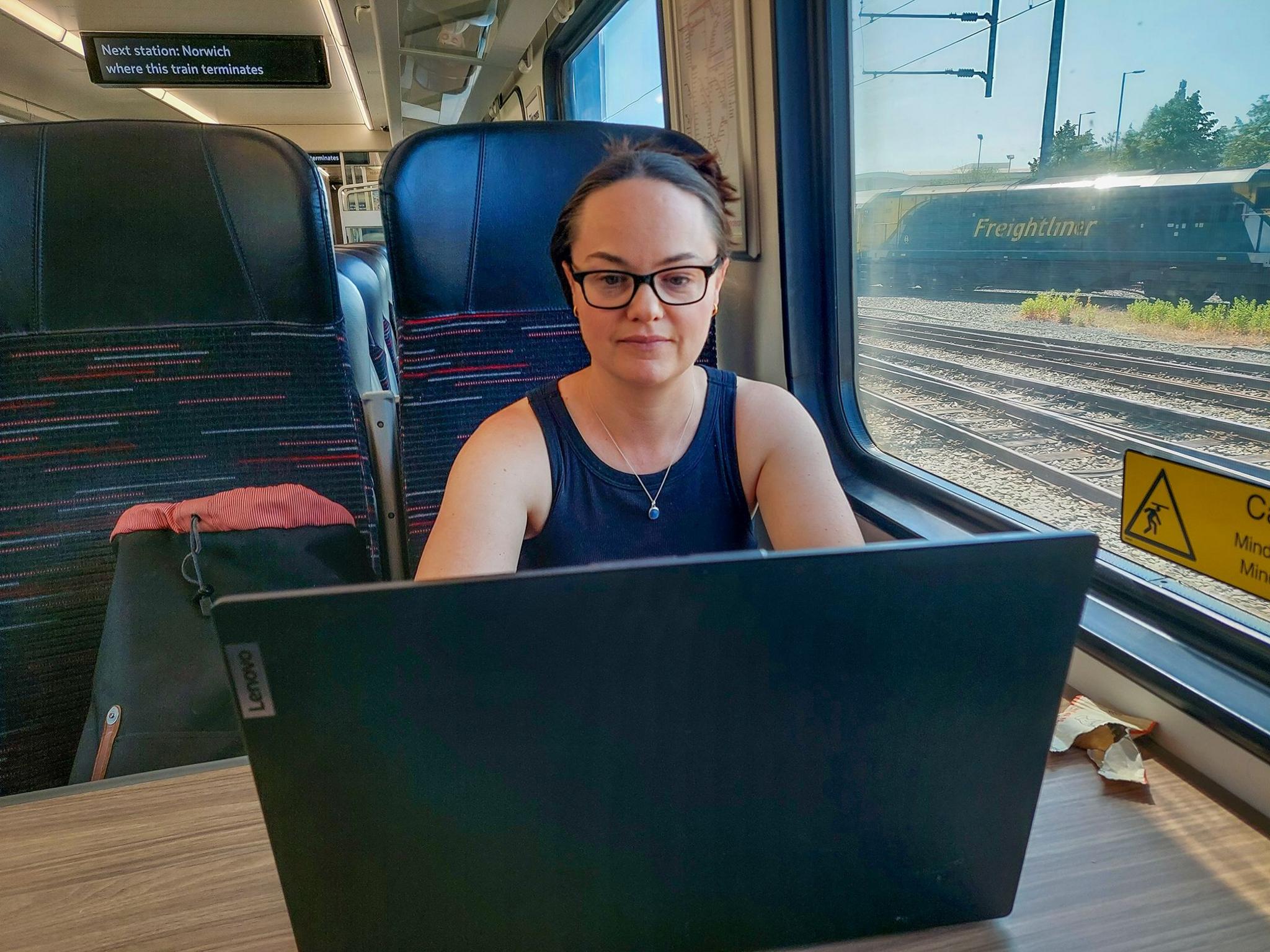
Commuters on trains between London and Norwich face a familiar problem: wi-fi that works some days and fails on others. Rebecca Kendall, 36, takes the train six times a month for her job as head of operations at a charity. She uses journeys to send emails and work on software, but the connection often forces her to skip important video calls.
"I just wouldn't risk having an important video call," Rebecca says, noting how unstable the connection often is. When audio calls are necessary, she warns colleagues that she might lose connection halfway through. On a typical two-hour journey, she can complete only about half the work she would do at her desk.
Poor train wi-fi affects millions of UK passengers. A 2025 report by network testing company Ookla ranked the UK's onboard wi-fi speed as 16th out of 18 major European and Asian countries. Average speeds on UK trains are just 1.09 megabits per second, compared to 64.58 megabits per second in Sweden and 29.79 in Switzerland. By contrast, the average download speed for UK homes is 285 megabits per second, according to Ofcom.
The problem stems from how train wi-fi currently works. Most operators use the same 4G and 5G mobile networks that passengers access directly on their phones. The Department for Transport explains: "If there is no signal outside the train, neither the wi-fi nor direct services will work." This means tunnels, rural areas, and congested networks all affect both phone signal and train wi-fi equally.
This week, the UK government announced a £57m plan to upgrade train wi-fi over the next five years. The project will equip 1,400 trains on mainline nationalised services to connect to low-earth satellites instead of relying solely on mobile networks. The Department for Transport aims to increase wi-fi availability from the current 50-60% to at least 90%. Speeds should increase between five and ten times.
Transport Secretary Heidi Alexander is expected to formally announce the plans this summer. The upgrade follows a trial of satellite connectivity with operators including LNER, South Western Railway, Great Western Railway, and services in Scotland.
For now, passengers cope with poor connections in various ways. Some, like Bhaav, 32, hotspot their phone data to laptops for work. Others avoid working entirely. Caitlin Roberts, 27, a teacher, usually brings a book or downloads TV shows in advance. She says the connection is often too weak even to load her train ticket. On one Greater Anglia train, the wi-fi dropped out repeatedly while a phone using 5G worked smoothly.
Maya Lane, 23, spends her journeys reading or crocheting. "We're not people who are super online all the time," she says. But she criticises operators for advertising wi-fi as a benefit when it is unreliable, especially for passengers who choose trains specifically to work during their commute. Sebastian Xavier, 29, and Ethan Sealy, 30, resort to playing cards when the connection fails.
Greater Anglia says its wi-fi quality varies depending on location and how many passengers use it at once. The operator also restricts access to some video and music-streaming sites, as do many others. Greater Anglia is monitoring performance and working with suppliers to improve service. For many passengers, the coming satellite upgrade cannot arrive soon enough.
Reporting incorporates material from a third-party source. Original